This post is brought to you by the Benjamin A. Gilman International Scholarship.
Note: This is going to be a long entry.
The 13th (day 28) was an interesting day because I got a chance to pursue a personal project not related to the field school. As a budding primatologist and lover of world mythology, [1] I’ve been collecting primate stories from all over the world in the hopes of one day archiving them on an internet database that can be accessed by both scholars and layman alike. I have a background in East and South Asian studies, so most of the stories that I have come from China and India. Oddly enough, I had zero material from Africa before leaving for the field school. That is why, while there, I approached Dr. Audax Mabulla, a professor of archaeology at the University of Dar es Salaam and the head of antiquities in Tanzania, for permission to record Maasai elders telling stories about primates. I had asked him about this early in the field season but didn’t think anything was going to come of it since he rarely visited camp. Then, while the field school students were washing fossils on the morning of the 13th, he approached and asked me to accompany him to deliver government papers for our planned safari the following day. Dr. Mabulla notified me that we would stop off at a Maasai settlement on our way back and that a Maasai translator would be waiting for me there.
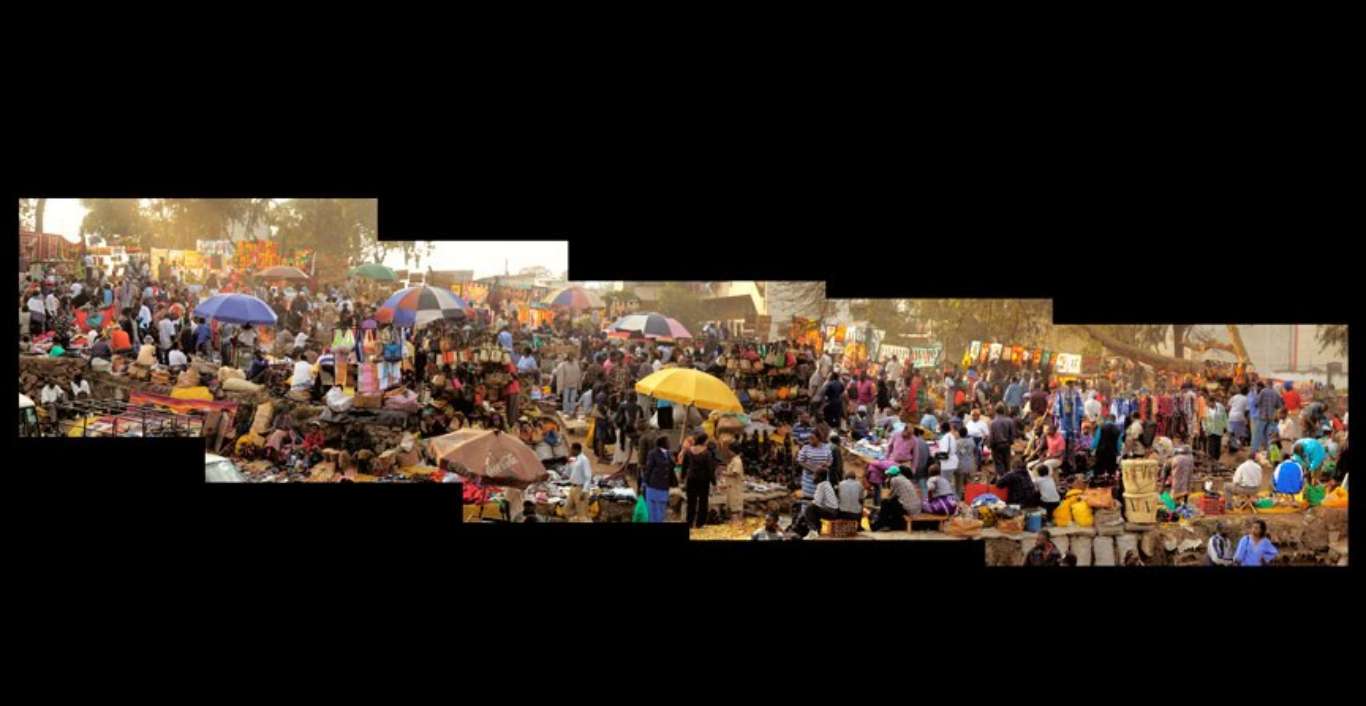
After the paperwork was taken care of, we drove to a small settlement on the outskirts of Endulen, the same area where we had attended the Maasai market. Dr. Mabulla got out of the truck and disappeared into what looked like a bar in order to find the interpreter. This gave me time to take in my surroundings. I saw a shanty town comprised of simple wooden buildings lining a road of red dirt. Apart from the bar, there was a feed mill and a cell phone provider mixed in with personal residences. Maasai stood on their porches or in the street conversing—many of them had their eyes locked on me. Goats and their kids roamed freely. The entrance of the settlement was protected by the shade of nearby trees, while the exit opened up into rolling green hills exposed to the sun. Dr. Mabulla emerged several minutes later with the interpreter in tow. He was a handsome young man wearing an extremely flashy western-style dress suit in various shades of purple. His attire contrasted with the simple plaid shuka wraps worn by the older individuals in town. He introduced himself as Joshua Olembario, a college-educated tour guide who had grown up in the area.
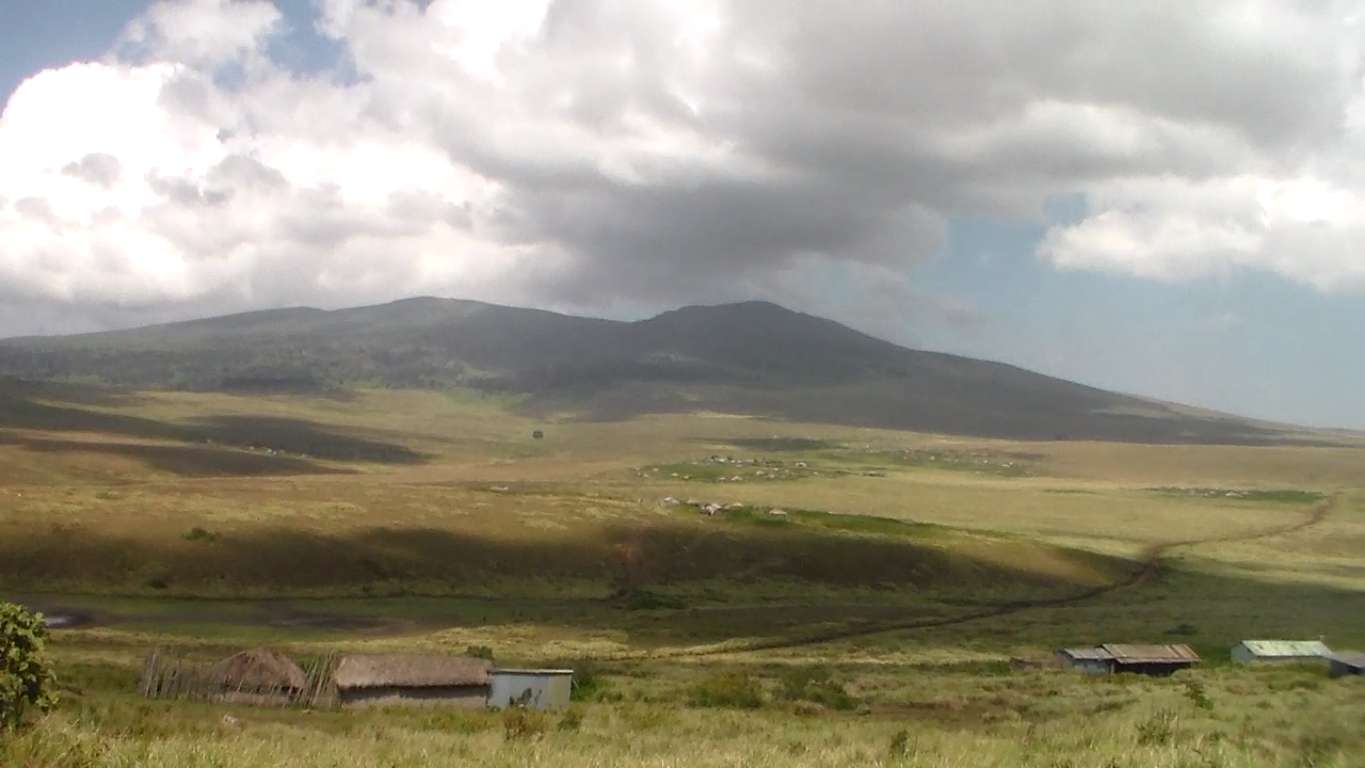
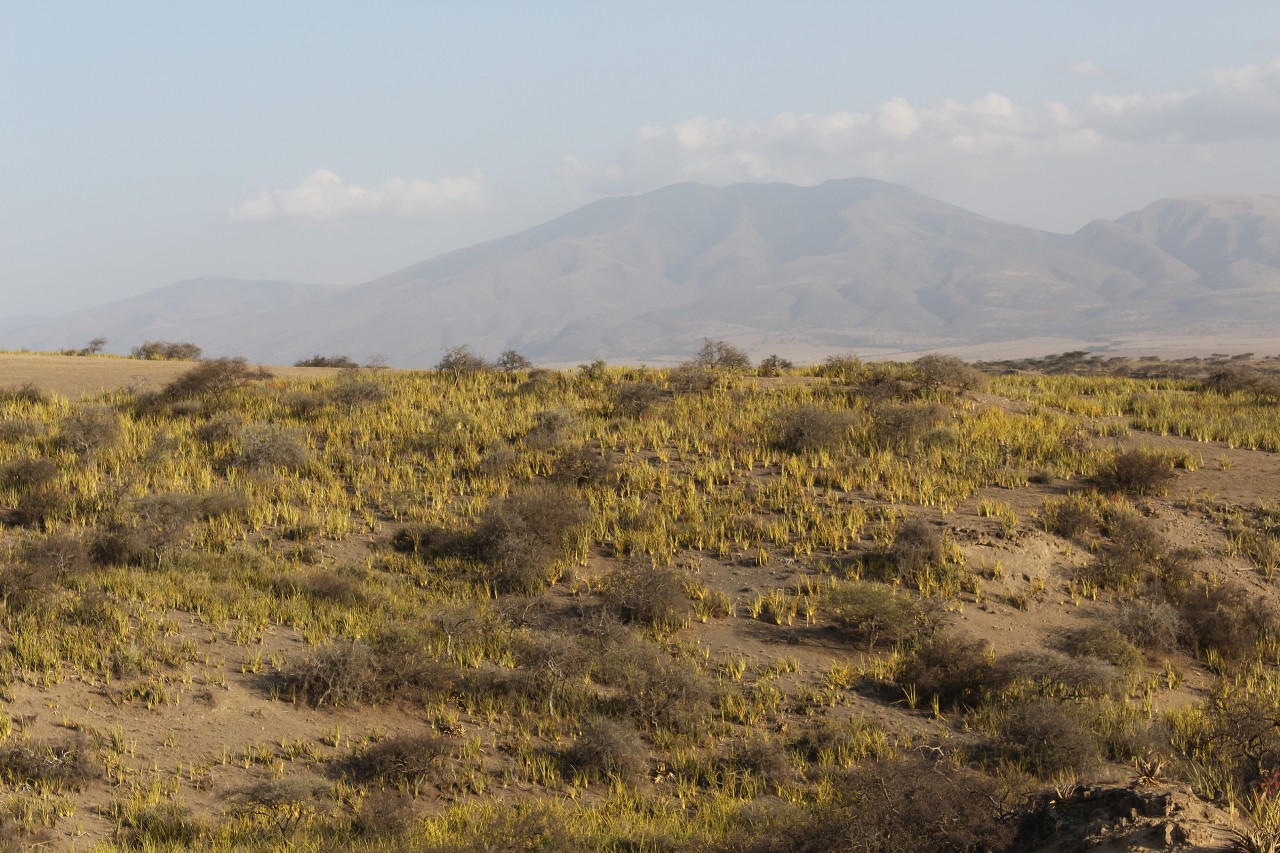
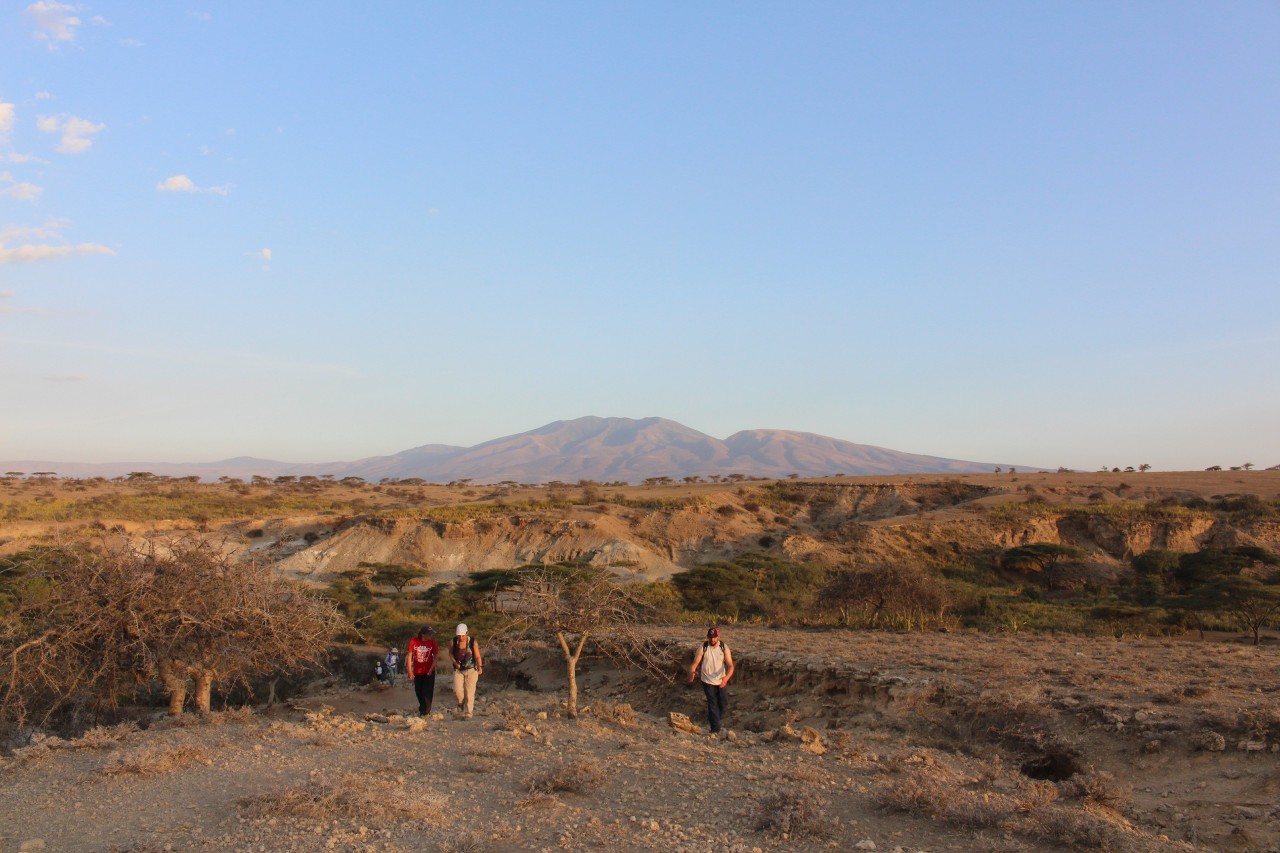
The mountain view from the back of the settlement (screen capture).
Joshua gave me a primer on Maasai beliefs before we approached five elders, all of whom agreed to tell their stories (one verbal and four on camera). [2] Most of what Joshua said was echoed by the elders, but I learned a little something new with each interview. Overall, I learned that the Maasai classify all wild animals and plants in familial clans similar to humans. They believe that it is forbidden to kill any wild animal because they all belong to God. [3] However, those clans that pose a threat to the Maasai and their livestock, such as big cats and hyenas, can be dispatched if the situation demands it. All monkeys and apes belong to the Lukumai clan. It is especially taboo to injure or kill a member of this clan because they are related to humans and thus share many similarities with us. The baboon, for example, is said to marry, have a nuclear family, and even care for and discipline their children just like their human cousins. Other similarities include begging for food with an outstretched hand and seeking out Maasai warriors for refuge from leopards. They also lactate as an apology if they startle a human in the forest (the Maasai believe humans do this too). Killing a Lukumai carries the heavy fine of forty-nine cattle to presumably be paid to community elders. The wealth of the Maasai is tied up in their livestock, so this punishment guarantees that no one will ever willingly break the law.

These gentlemen were the first two Maasai elders that I interviewed
with Joshua’s help (screen capture).

The translator Joshua and a Maasai eldress, the third person I interviewed
(screen capture).

Clemens, the fifth and last Maasai elder (screen capture). He was my favorite
interview because he was so animated while telling stories. He picked up
English when he was invited to stay in America for a year during the 1970s.
One Maasai eldress I spoke with said that she believed the Hadza (a.k.a., Hadzabe) people evolved from baboons. They are one of the last hunter-gatherer groups in the world and live a life considered to be primitive by Maasai standards. Dr. Mabulla was surprised to learn of her story because the Hadza actually eat baboons as a part of their diet. The meat is considered to be a delicacy with medicinal properties. However, due to the morphological similarities between humans and baboons, the Hadza believe that they must be “brave” when aiming their bow and arrow at the monkey.
Dr. Mabulla was also surprised to learn that the Maasai place all primates in the Lukumai clan for this is actually a human clan name. It is one of the six founding Maasai clans. They are Lukumai, Laiser, Molelian, Mokesan, Tarosero and Mamas ita (Berntsen, 1973: 12). There were originally five clans according to one version of the Maasai creation legend. In the beginning, the creator god Naiteru-kop married two women, each who respectively lived to the right and left of the gateway to his domain. The first wife was given red cattle, while the second was given black cattle (this may point to some color-coded dichotomy between good and evil). [4] The former eventually gave birth to three sons, while the latter gave birth to two. Each would become the founder of the five clans. This means that three of the clans (Molelian, Mokesan, and Tarosero) fall under the moiety of the red cattle and the other two (Laiser and Lukumai) fall under the black cattle (Allan, 1990: 179). All monkeys and apes therefore fall under the moiety of the black cattle since they belong to clan Lukumai. Being placed in such a clan shows just how important primates are to the Maasai.
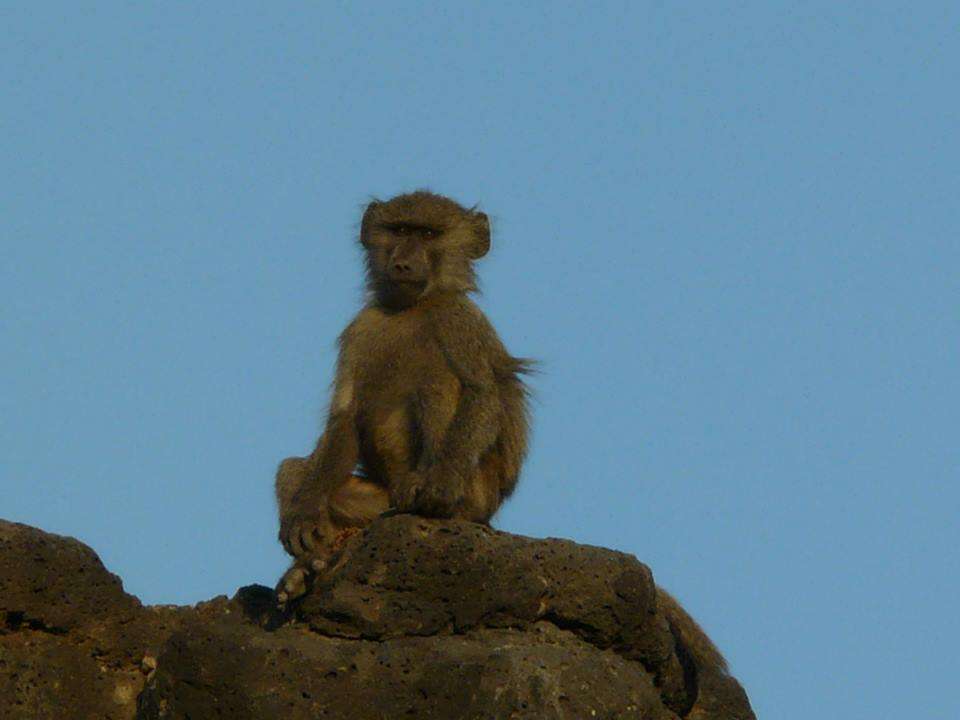
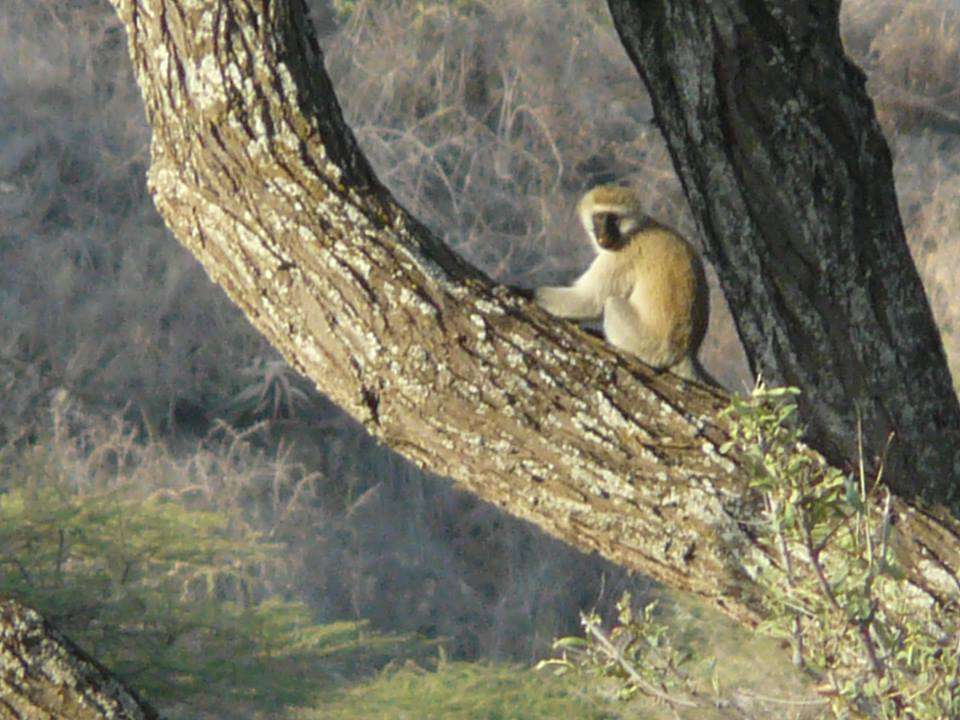
A juvenile baboon (photo by Alexa).
Dr. Mabulla and I returned to camp about an hour after lunch had started. Following our afternoon break, the field school students drove to Kelogi Hills, a collection of massive rock formations known for the presence of tribal rock art. There, Dr. Mabulla gave us a brief lecture in which he explained that East Africa has the second largest collection of rock art in the world next to Europe. There are around 400 sites in Tanzania alone with rock art, some of which fall under UNESCO. A survey of these sites reveals four categories of rock painting: Hunter-gatherer, Pastoral, Bantu-Speaking art, and Maasai Olupul traditions. The Hunter-gatherer rock art goes back at least 5,000 years and has three modes of expression. The first is stylized human figures involved in daily activities, such as men hunting and groups of women digging (presumably for water and/or underground vegetation). Animals, primarily giraffes, are represented naturalistically. The second is mythical figures with elongated half-human-half-animal forms. These could represent shamans. The third is geometric designs consisting of concentric circles and lines. This category is known for its red color and fine lines that were most likely produced with some form of brush. [5] Pastoral art goes back 3,000 to 4,000 years and consists primarily of cows and other animals painted in red and white colors. [6] Bantu-Speaking art goes back 2,000 years and consists of stylized humans and fingerprints painted with a dirty white color. [7] Maasai Olupul art goes back hundreds of years and consists primarily of symbols associated with warriors (e.g., shields). This category of art is painted by Maasai warriors during month-long excursions into the bush where they take part in Olupul, a meat-eating feast around a camp fire.

An example of the beautiful rock formations at Kelogi
Hills (photo by Alexa).

A super ritzy hotel in the area (photo by Alexa).
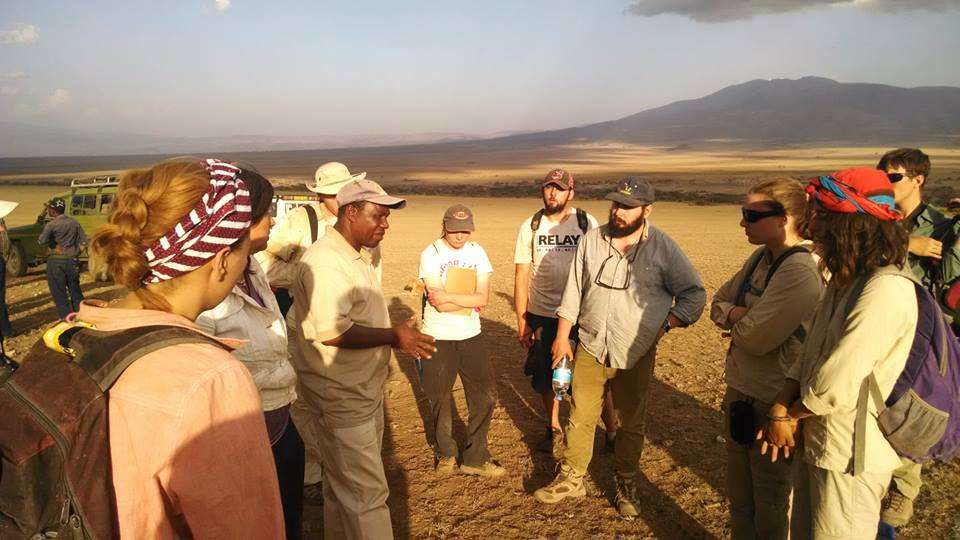
Dr. Mabulla lecturing (photo by Andy).
The point of our visit to Kelogi Hills that evening was to look at an example of Maasai Olupul art that had been produced within the last two to three centuries. It was situated on the broad face of a natural rock shelter located at the top of a tall geological formation. The group hiked up a very steep incline covered in oldupai grass and sticker bushes to reach the summit. There, we saw a faded composition of two stylized shields and a bell flanked by animals on both sides. The shields were parallel rectangles with rounded corners. Each was outlined in white and decorated with black half circles in each corner and red and black lines running down the middle. The bell, a stylized double chevron painted in white, was situated to the left of the shields. The flanking animals were red. Those to the right were identified as giraffes based on their long necks. Those to the left, however, couldn’t be identified due to being too weathered. Dr. Mabulla noted that the colors were derived from ash (black), ochre (red), and crushed stone (white).

The natural rock shelter decorated with Maasai Olupul art (photo by Heather).
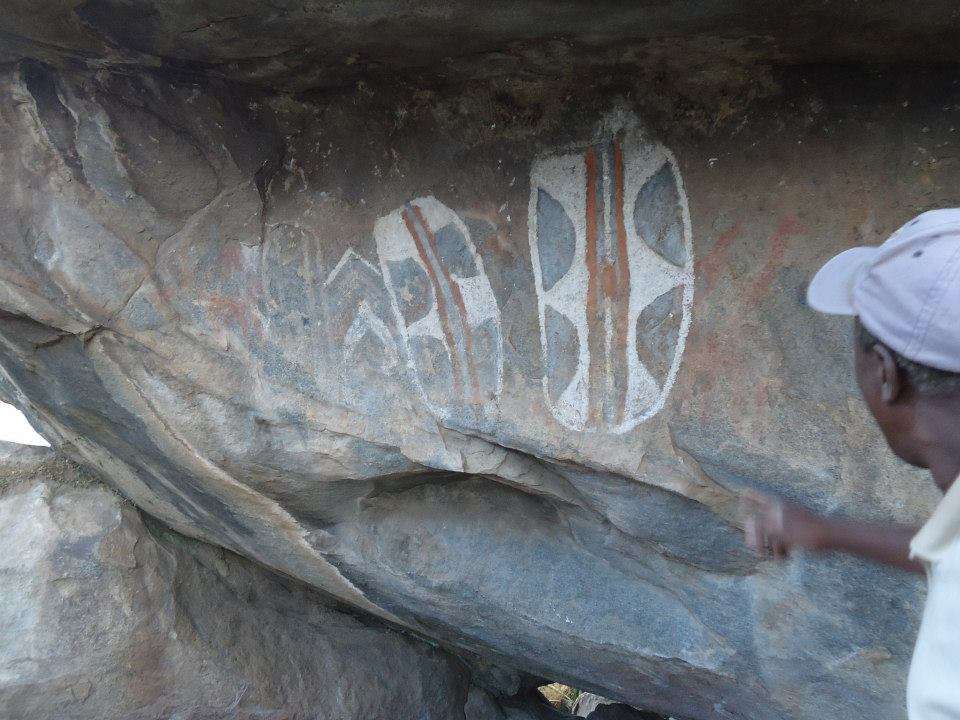
Dr. Mabulla describing the features (photo by Heather).
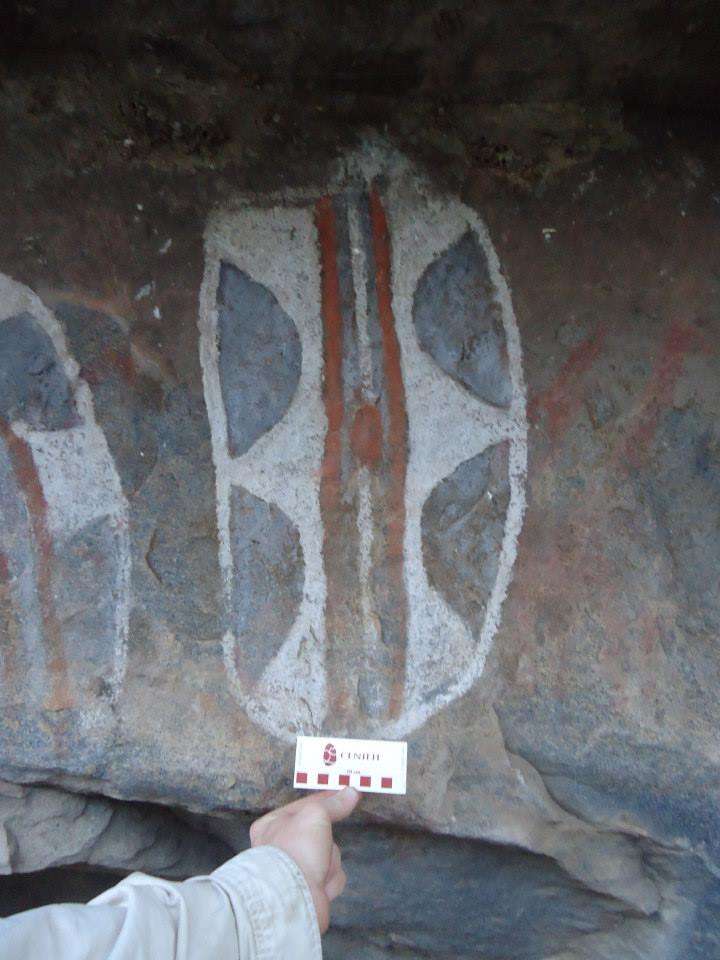
The largest shield next to a 10 cm scale bar (photo by Heather).
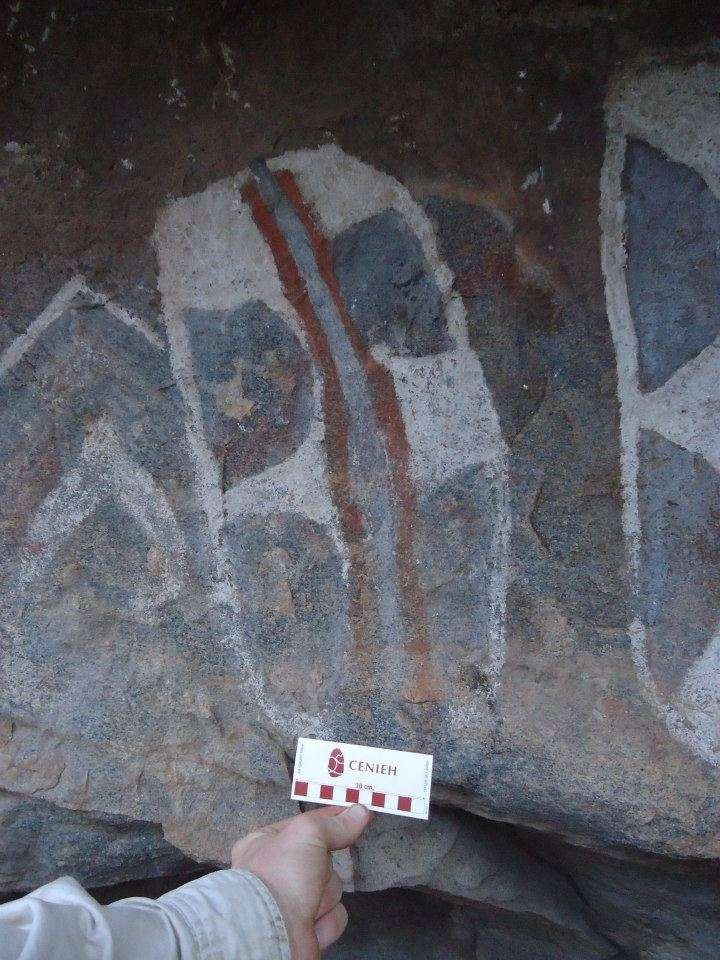
The second largest shield with scale bar (photo by Heather).
Charles suggested that we climb a neighboring rock formation as the sun started to set. The much taller summit required us to scale a nearly vertical rock face in order to reach the top. We emerged onto an uneven plateau bestrewn with boulders. This elevated vantage point gave us a sweeping view of the surrounding area—we could see for at least ten miles in every direction (maybe more). We were so high off the ground, in fact, that the people in the Maasai kraal beneath us looked like ants. Everyone took this opportunity to snap photos of themselves and/or the beautiful landscape. The Triforce ™ climbed out onto a natural stone pillar for a team photo. Now, I’m not afraid of heights, but I was a little scared because Rachel and Heather were a little too rowdy in that moment. Add to that strong gusts of wind and you are almost guaranteed a health insurance premium increase. Luckily I was able to avoid falling to my death thanks to cat-like balance and reflexes honed over many years. Before leaving, the students took a group photo with Dr. Mabulla. We returned to camp shortly thereafter. Thus ended our last full day at the field school.
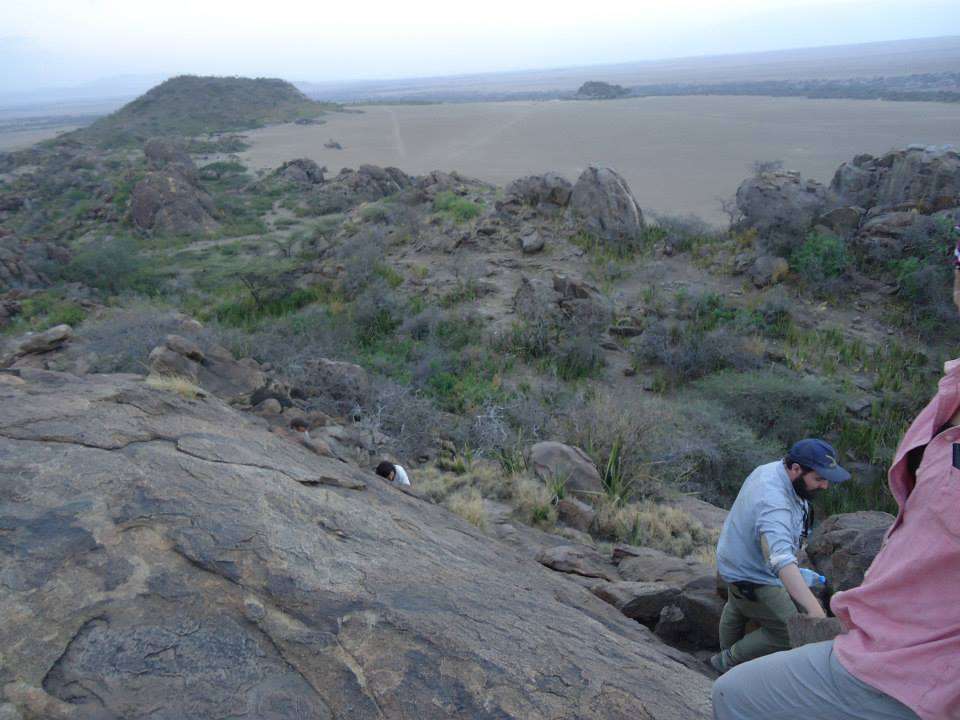
The climb up (photo by Heather).
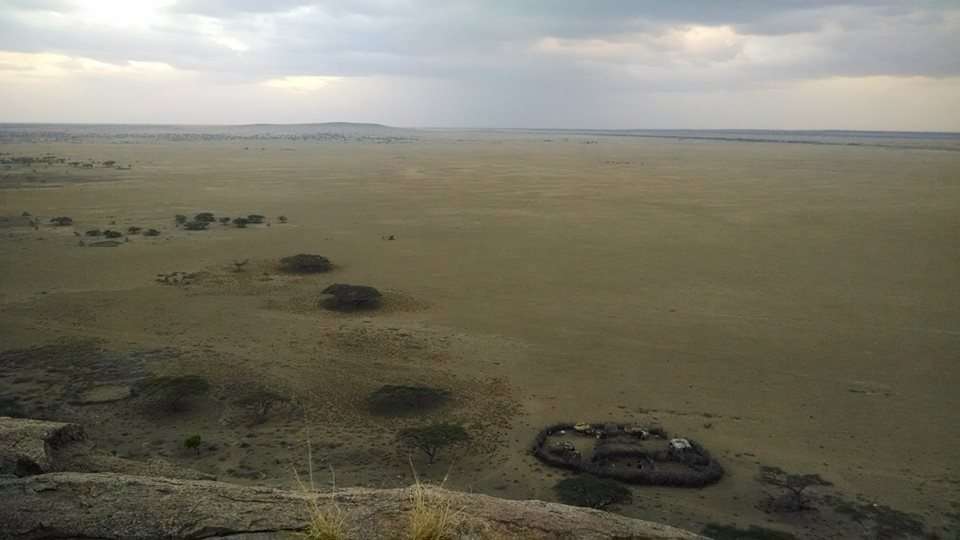
The view from the top (photo by Andy?).
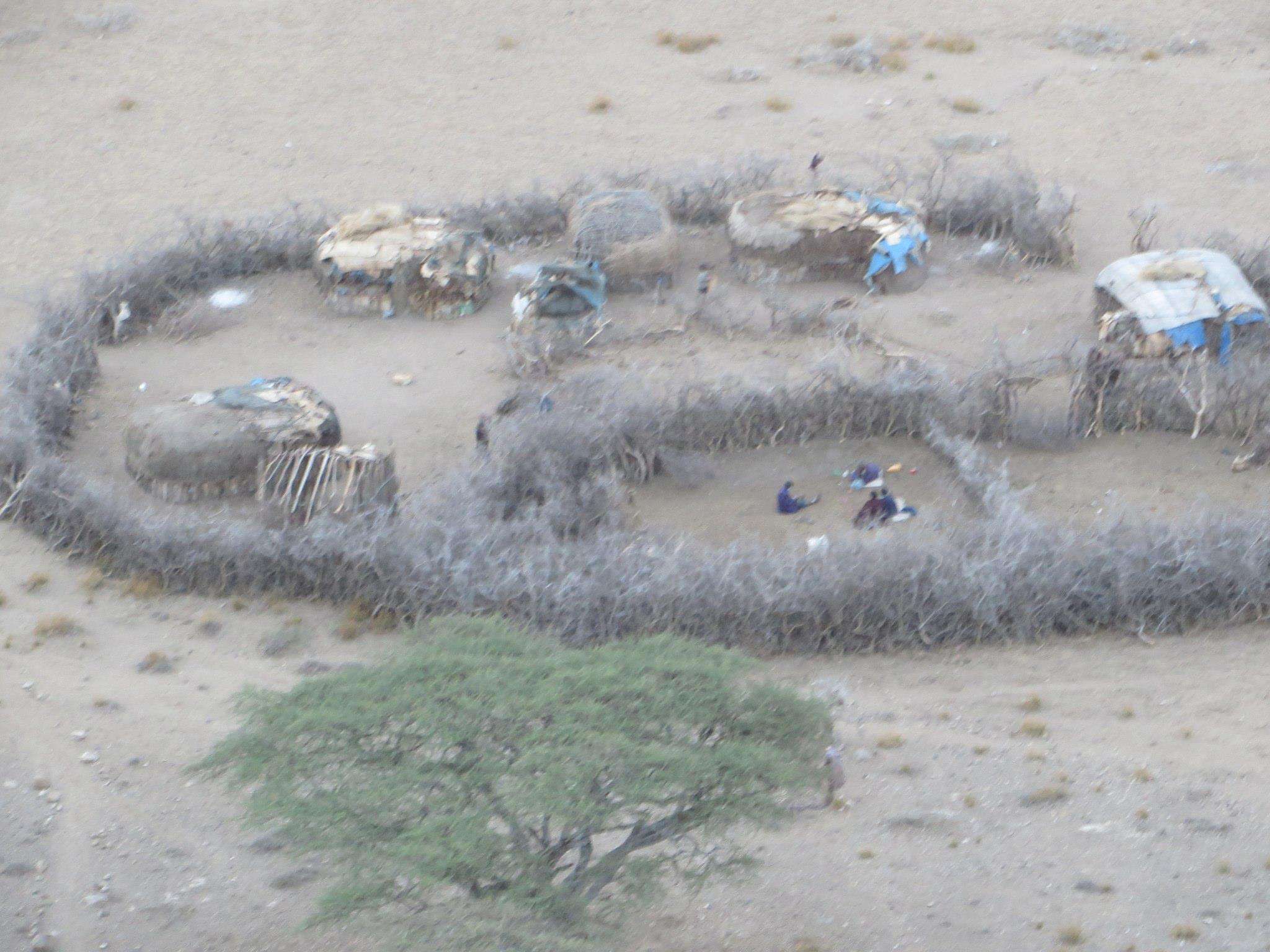
A zoomed photo of the Maasai kraal beneath us (photo by Rachel).
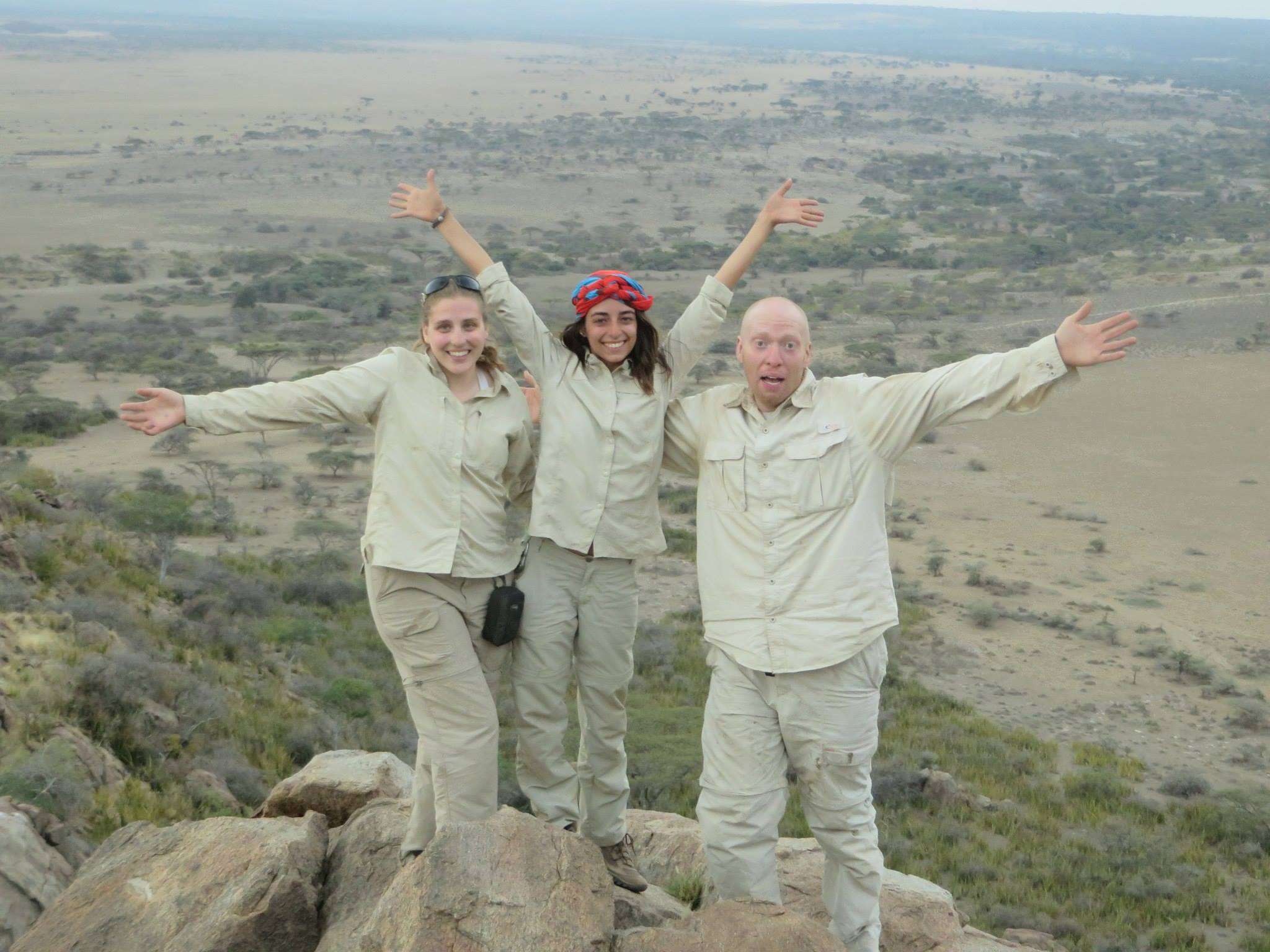
The Triforce ™ team photo (that is my “hurry up and take the picture because
I don’t want to die” face).
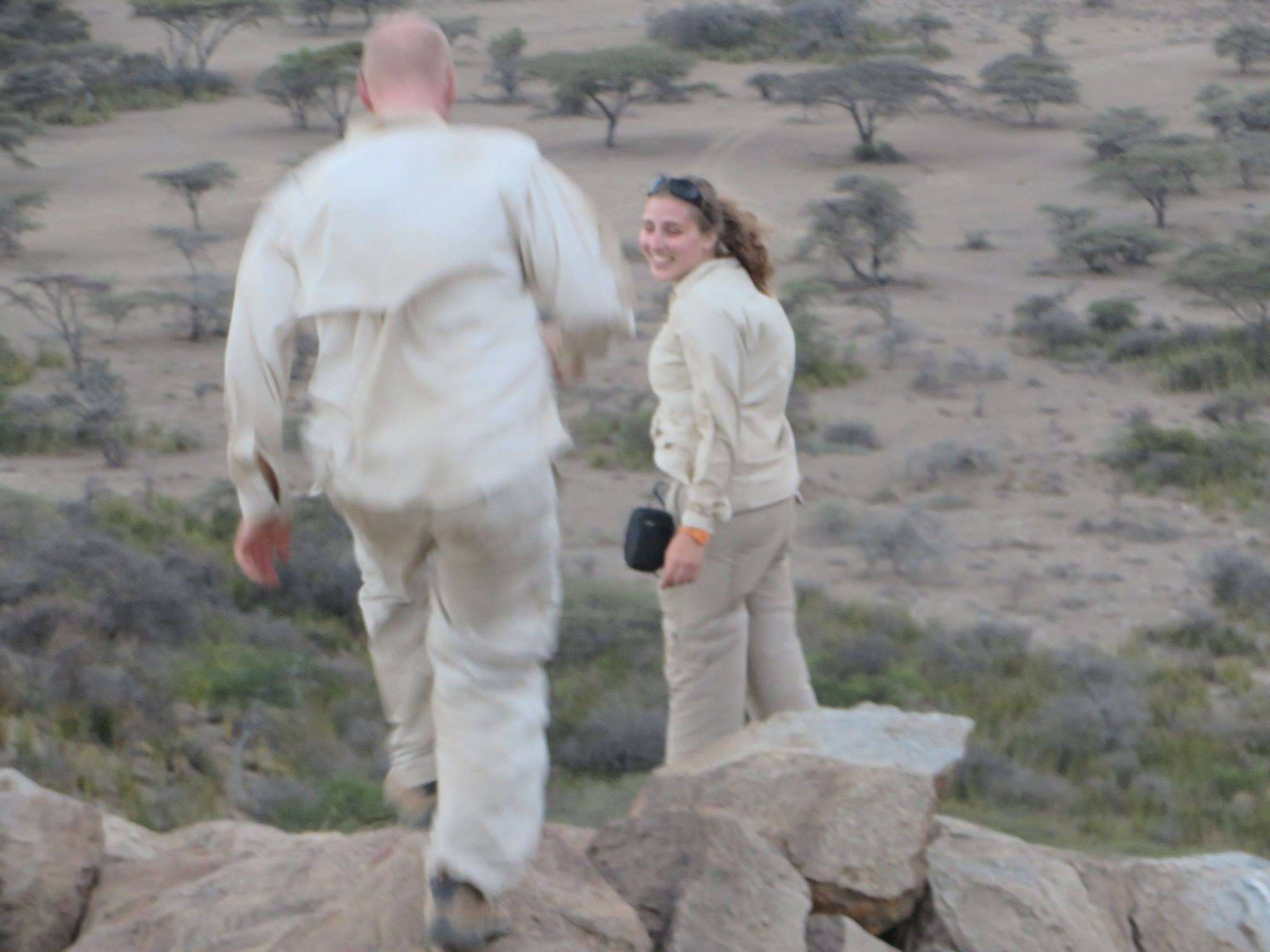
Me attempting to push Rachel off the cliff because she was talking smack.
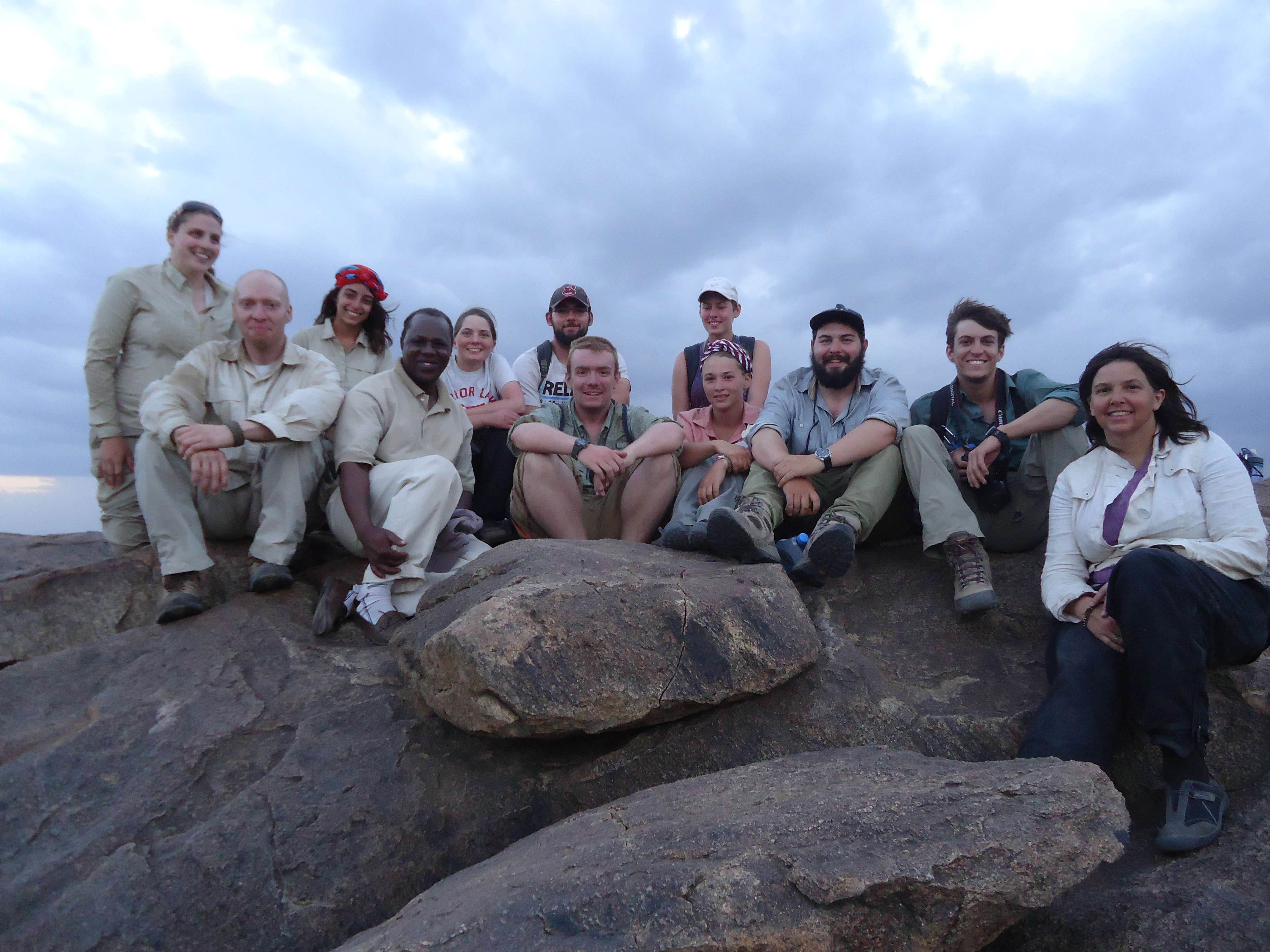
Our last group photo. (Starting from the left) Rachel, Me, Heather, Dr. Mabulla,
Meghan, Adam, Andy, Alexa, Kat, Curran, Zach, and Cindy.
Notes
[1] When I say “myth”, I’m using the Oxford Dictionary definition of the word: “A traditional story, especially one concerning the early history of a people or explaining some natural or social phenomenon, and typically involving supernatural beings or events”. I pass no judgement on the validity of any story classified as a myth. Cultural relativity teaches us to view each story from the point of view of the originating culture, whether in the past or present. Therefore, the Greco-Roman creation story is just as valid as that for the Judeo-Christian religion. The same can be said for the Maasai creation story.
[2] Each elder was compensated for their time. I had actually forgotten to bring money with me since we left camp in such a hurry. I am indebted to Joshua for both making the introductions and fronting me the funds to pay the elders. I later repaid him the total amount plus interest.
[3] I neglected to ask if the deity in question was a local god or if it was the god of the Judeo-Christian religion. I know at least one elder that I interviewed was Christian (or was at least formerly Christian). See note four below for more information on Maasai deities.
[4] I can’t take credit for this hypothesis. It was suggested here and explained here. The supreme creator deity Ngai has two manifestations: the black benevolent form is known as Ngai Naroke, while the red angry form is known as Ngai Na-nyokie. I am not sure if Ngai is synonymous with the previously mentioned creator god Naiteru-kop.
[5] Dr. Mabulla noted that the red color was Ochre, which was most likely combined with animal fat to make paint. Shells containing 100,000 year old ochre paint were discovered by archaeologists in Blombos cave, South Africa. It was been suggested that the substance was used for decorating the body.
[6] Notice how the subjects portrayed are those most important to the people of their given time period. The hunter-gatherers depict hunting scenes and naturalistic animals because this was their primary means of subsistence as semi-nomadic people. The pastoralists, on the other hand, depict primarily cows because they were so important to such sedentary people.
[7] Bantu-speaking art is named in honor of a West African people who migrated to East and South Africa displacing local hunter-gatherer groups when they moved into the area.
Bibliography
Allan, K. (1990). Discourse stratagems in a Maasai story. In Current approaches to African linguistics: Volume 7 (pp. 179-191). Dordrecht: Foris Publications.
Berntsen, J. L. (1973). Maasai and Iloikop: Ritual experts and their followers (Master’s thesis). University of Wisconsin—Madison.